TL;DR
Evening exercise is usually safe and can improve sleep if timed 1–4 hours before bed, with light to moderate intensity preferred closer to bedtime. Vigorous workouts right before sleep may delay sleep onset, but moderate activity typically has neutral or positive effects.
Executive Summary
Contrary to traditional advice, evidence shows that evening exercise is generally not harmful and often improves sleep, especially when moderate in intensity and not immediately before bed. Meta-analyses find no overall negative effects – indeed, one review concluded evening exercise “does not support the hypothesis” of sleep disruption[1]. High-intensity workouts very close to bedtime can delay sleep onset and reduce total sleep time, but moderate or light exercise ≥60–90 minutes before sleep typically has no adverse effect[1][2]. A large wearable-device study (N≈14,700) confirms a dose-response: exercise ending ≥4 h before sleep is “not associated with changes” in sleep, whereas late high-strain exercise delays sleep and lowers sleep quality[3][4]. Key outcomes – sleep latency, duration, efficiency, and architecture – are mostly unchanged or even improved by evening exercise, except in cases of very late vigorous exertion. Practical recommendations are to end intense workouts at least 2–4 hours pre-sleep or opt for light/moderate activity closer to bedtime. The impact varies by age, health status, chronotype, and exercise type. Major gaps include a need for large RCTs in diverse populations and clearer guidelines on timing by intensity.
Definitions
- Timing Categories: We define “evening exercise” broadly as any exercise performed after late afternoon. More specifically, we consider exercise ending within 30 min of bedtime as “immediately before bed,” 30–60 min as “shortly before bed,” 1–2 h as “late-evening,” 2–4 h as “early-evening,” and >4 h as “earlier in the day.” (Bedtime refers to habitual sleep-onset.)
- Intensity & Duration: Exercise intensity is commonly classified by percentage of maximal heart rate (HR_max) or oxygen uptake (VO₂_max). Moderate intensity is roughly 50–75% HR_max (e.g. brisk walking, light jogging), and vigorous (high) intensity ≳75% HR_max (e.g. running, high-intensity intervals). For example, Miller et al. had subjects do 30 min at 75% HR_max (moderate)[2]. Low intensity might be casual walking or yoga. We distinguish short bouts (<30 min), typical sessions (30–60 min), and prolonged/strenuous (>60 min or very high intensity). Sleep outcomes measured include objective polysomnography (or actigraphy) metrics (sleep latency, total sleep time, wake after sleep onset, sleep efficiency, stage distribution) and subjective quality (questionnaires).
Physiological Mechanisms
Evening exercise engages multiple physiological systems that can influence sleep. Key factors include:
- Core Body Temperature: Exercise raises core temperature, but sleep onset normally requires a downward temperature shift. If vigorous exercise ends <90 min before bed, body temperature may still be elevated, potentially delaying sleep[2]. For example, Miller et al. found core temperature returned to baseline ~90 min after moderate exercise, so sleep was unimpaired[2]. Inadequate cooling time could prolong sleep-onset latency.
- Autonomic Arousal and Recovery: Strenuous exercise activates the sympathetic nervous system (↑heart rate, ↑respiration, ↑cortisol) and suppresses parasympathetic tone. Full parasympathetic (vagal) recovery can take several hours after high-intensity sessions[5][6]. If this “autonomic recovery” is incomplete by bedtime, sleep may be delayed or fragmented. Leota et al. showed that high-strain, late-evening exercise was associated with higher nocturnal heart rate and lower heart-rate variability, reflecting poor parasympathetic recovery, which correlated with shorter, lower-quality sleep[3][5]. In contrast, light/moderate exercise permits recovery in time for normal sleep physiology.
- Cortisol and Stress Hormones: Exercise increases cortisol and adrenaline acutely. Elevated cortisol in the late evening (especially after heavy exercise) could inhibit melatonin release and promote alertness. Some studies note higher cortisol after late workouts, though direct impacts on sleep remain under investigation[7].
- Circadian Phase and Melatonin: Late-night exercise (especially under bright gym lights) can shift the circadian clock. Intense evening exercise has been shown to delay melatonin onset on subsequent evenings, similarly to light exposure[8]. Such phase delays might make it harder to fall asleep at one’s usual time. Timing exercise well before bedtime (>2–4 h) minimizes this effect.
- Sleep Architecture: Meta-analyses indicate evening exercise modestly enhances some sleep stages. Stutz et al. (2019) reported that, on average, evening workouts increased slow-wave sleep (deep sleep) by ~1.3 percentage points and lengthened REM latency by ~7.7 min, while reducing light (Stage 1) sleep[9]. These shifts suggest deeper, more restorative sleep. However, extremely late/vigorous exercise can transiently reduce REM sleep (Frimpong et al. found a ~2.3% REM decrease)[6].
- Arousal and Anxiety: Exercise also releases endorphins and reduces anxiety, which can promote sleep. For many people, the net effect of moderate evening exercise is calming and beneficial for sleep drive. This is reflected in findings that post-exercise anxiety reduction correlates with longer sleep in some insomnia patients[10].
In summary, evening exercise induces temporary physiological arousal (heat and sympathetic activation) which, if too intense or too close to bedtime, can oppose sleep onset. If sufficient recovery time is allowed (cool-down, shower, time for HR to fall), the exercise benefits (tiredness, mood improvement) tend to predominate.
Evidence Hierarchy
Systematic Reviews & Meta-Analyses: Several recent reviews have synthesized the literature on evening exercise and sleep. Stutz et al. (2019) performed a meta-analysis of 23 RCTs in healthy adults and found no evidence that evening exercise worsens sleep; indeed, REM latency and deep sleep increased slightly[9]. Frimpong et al. (2021) reviewed 15 trials of high-intensity evening exercise and found only a small reduction in REM (–2.3%) and no other sleep disruptions[6]. Kim et al. (2023) summarized circadian physiology and noted that short-term evening exercise can delay melatonin and raise nocturnal temperature, but found no consistent negative effects on overall sleep quality. A large network meta-analysis on insomnia (up to 2025) compared exercise types and concluded that yoga, Tai Chi, and walking/jogging are among the most effective exercise interventions for chronic insomnia, often outperforming other treatments[11].
Randomized Controlled Trials: Experimental RCTs directly compare evening exercise to control. For example, Miller et al. (2019) had 12 healthy men perform 30 min of moderate aerobic or resistance exercise ending 90 min before bedtime; neither exercise bout altered sleep latency, duration, efficiency, or stages compared to no exercise[2]. Seol et al. (2020) randomized 60 older adults to 30 min low-intensity aerobic exercise either in the evening (18:00–bed) or morning; the evening group showed significantly shorter sleep latency and higher sleep satisfaction at 8 weeks[12][13]. Conversely, Youngstedt et al. (2021) studied sedentary insomnia patients who did 30 min moderate treadmill + 15 min resistance exercise 2 h before bed. On average, sleep was not significantly changed, but two of 12 participants had severe sleep disruption after the exercise night[10][14]. These trials illustrate that healthy individuals generally tolerate moderate evening workouts well, while some with insomnia or low fitness may be more sensitive.
Observational Studies: Wearable-device cohort studies provide real-world data. Leota et al. (2025) analyzed 4 million nights of sleep from ~14,700 adults wearing fitness trackers. They found that later exercise timing and higher exercise strain predicted delayed sleep onset, shorter sleep duration, and lower sleep quality, in a graded (dose-response) way[3]. Crucially, exercise ending ≥4 h before bedtime showed no adverse effect on sleep parameters[4]. These observational findings align with RCTs, but apply to a broad, free-living population.
Sleep & Sports Guidelines: Historically, sleep hygiene guidelines cautioned against any vigorous exercise after ~3 h before bedtime. More recent advice is moderated. For example, SleepFoundation (2021) notes that vigorous exercise within 1 h of bedtime may not allow core temperature to drop, potentially delaying sleep, whereas moderate exercise finished earlier (≥90 min) is generally safe. Sports medicine guidelines (e.g. ACSM) emphasize regular exercise for sleep health but also suggest allowing at least 1–2 h for recovery from hard workouts. None of the major guidelines mandate no evening exercise, but many advise timing and intensity considerations.
Timing Effects
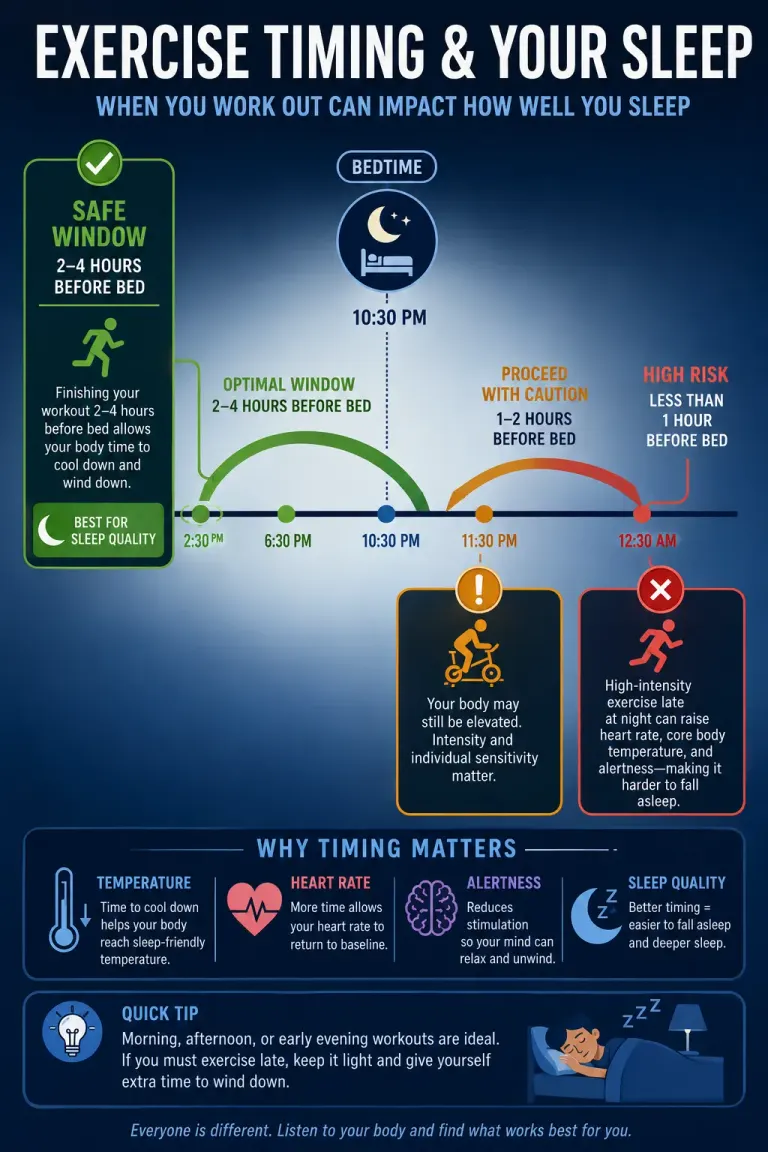
The impact of exercise on sleep depends critically on how close to bedtime it occurs. Key findings by timing window:
- <30 minutes before bed: Exercise this close is rare, but it is highest risk. Very late intense workouts often produce immediate arousal, and most studies avoid this. If it occurs, expect delayed sleep onset and possibly reduced total sleep (TST) and efficiency (SE). (Stutz et al. noted that “sleep-onset latency, total sleep time, and SE might be impaired after vigorous exercise ending ≤1 h before bedtime”[1].)
- 30–60 minutes before bed: Moderate-intensity activity may still be okay, but vigilance is advised. Miller et al. showed that ending a 30-min moderate session ~90 min pre-bed had no effect[2], so ending at ~30 min could risk incomplete cooling. Anecdotally, some people fall asleep right after a gym session, others find it too stimulating. In general, keeping intensity low-to-moderate (e.g. yoga, easy walking) in the half-hour before bed is unlikely to harm sleep, whereas sprinting or HIIT is not recommended.
- 1–2 hours before bed: This is a transition zone. Moderate-intensity exercise 1–2 h pre-sleep is widely considered safe and often beneficial[2]. For example, Miller et al. (30 min at 75% HR_max, ending ~90 min before bed) had no sleep impact[2]. High-intensity exercise 2 h before bed also tends to be tolerated: Frimpong et al. reported that in healthy adults, acute HIE ending 2–4 h pre-bed “does not disrupt sleep” except a slight REM reduction[6]. However, shorter recovery (e.g. HIE ending <1 h pre-bed) can raise HR and cortisol, delaying sleep (as seen in older studies and in 2/12 insomniacs in Youngstedt’s trial[10]).
- 2–4 hours before bed: Exercise in this window has minimal risk. Both observational and trial data show sleep is generally unaffected or even improved. Frimpong et al. found no sleep disruptions for HIE in this range[6]. Leota et al. confirmed that when exercise ends ≥~2 h before sleep, onset and quality were similar to nights without exercise[15]. It’s an ideal window to fit moderate or even intense workouts.
- ≥4 hours before bed: Essentially safe for all intensities. Late afternoon/early-evening exercise finished ≥4 h before bedtime showed no negative effects on any sleep metric[3][4]. The Nature Comm study suggests concluding workouts by this point if maximal sleep health is the goal.
Overall, the general rule is: the closer to bedtime, the lower the recommended intensity. Many experts suggest allowing at least 90–120 minutes between the end of vigorous exercise and sleep[2][4]. If exercise must occur late, keeping it light or moderate (brisk walking, easy cycling, gentle yoga) greatly reduces the chance of sleep disruption. Scheduling strenuous exercise earlier in the evening or afternoon is ideal.
Exercise Types
Different exercise modalities may differ in their evening sleep effects:
- Aerobic (Endurance) Exercise: Jogging, cycling, swimming, etc. Most research focuses on aerobic exercise. In healthy adults, even moderate or vigorous evening aerobic workouts (finished 1–2 h before bed) do not impair sleep[2][6]. In fact, acute aerobic exercise often improves subjective sleepiness and can enhance slow-wave sleep. For example, Miller et al. found that 30 min of moderate aerobic exercise ending 90 min pre-bed raised core temperature during exercise but returned to baseline by bedtime, with no change in sleep architecture[2]. Long-term regular aerobic training also generally improves sleep quality (though timing is less studied).
- Resistance (Strength) Exercise: Weightlifting and resistance training are less studied, but available evidence is reassuring. The Miller study also had a 30-min resistance exercise arm (at 75% 10RM) ending 90 min pre-bed; like aerobic exercise, it did not affect subsequent sleep[2]. Another trial (Passos et al., 2019) showed that an 8-week program of moderate resistance training improved sleep in chronic insomnia patients. The BMJ-based network meta-analysis (insomnia trials) found that combined aerobic+strength or strength alone are effective for improving insomnia severity, though slightly less so than yoga and Tai Chi[11]. Resistance exercise acutely raises muscle temperature, but again, if done ≥1–2 h before bedtime, most subjects recover well.
- High-Intensity Interval Training (HIIT): Short bursts of very intense effort (e.g. sprints, circuit training). HIIT causes large spikes in heart rate and adrenaline, so timing is crucial. Meta-analysis (Frimpong et al.) found that a single high-intensity session ≤4 h pre-bed slightly reduced REM sleep (–2.3%) but did not affect total sleep time or other stages[6]. Laboratory studies report that HIIT ending <1 h pre-bed can prolong sleep latency by ~14 min and elevate HR at bedtime. Therefore, HIIT is best scheduled at least 2+ hours before sleep. If done closer, expect modest difficulty falling asleep, especially in less-trained individuals. However, even late HIIT has not been shown to have large detrimental effects on healthy adults’ overall sleep.
- Mind-Body / Relaxation Exercises (Yoga, Tai Chi, Stretching): These are generally recommended in the evening. They combine low aerobic strain with stress reduction. A network meta-analysis of insomnia RCTs found that yoga was among the most effective exercise types, increasing total sleep time by ~2 hours and sleep efficiency by ~15% compared to control[11]. Tai Chi and light to moderate walking also significantly improved sleep outcomes. These forms of exercise likely help by reducing arousal and promoting relaxation before bed. Gentle yoga or stretching in the late evening often serves as a useful wind-down routine, in contrast to vigorous workouts.
- Other Forms (Walking, Household Activity): Even routine physical activities like walking, gardening or household chores can influence sleep. One small study had women do household tasks before bed and found no impairment of sleep efficiency, despite higher body temperature during activity[2]. In practice, a casual stroll or chores are not problematic. More aerobic walking/jogging as formal exercise has been shown to improve insomnia severity and sleep quality[11].
In summary, any exercise type can benefit sleep if timed and dosed appropriately. Moderate aerobic and resistance training are safe in the early evening. HIIT and strenuous exercise require longer recovery. Yoga, stretching, and low-intensity workouts are especially compatible with improving sleep when done late.
Population Subgroups
- Healthy Adults: Most studies involve healthy 18–50 year-olds. In this group, evening exercise is generally neutral or beneficial for sleep. The aforementioned meta-analyses (Stutz; Frimpong) and trials (Miller, others) all show minimal adverse effects[1][2]. Individual factors like chronotype matter: e.g. one study found that “morning-type” individuals had worse sleep than evening-types after an evening HIIT session[7]. Thus, a person’s natural sleep-wake preference can influence how they respond to late exercise.
- Older Adults: Aging is associated with lighter, more fragmented sleep. Some evidence suggests low-intensity evening exercise may help older adults. Seol et al. (2020) found that in healthy seniors (~65+), 8 weeks of 30 min low-int aerobic exercise at night improved sleep latency and satisfaction more than morning exercise[12][13]. Another study (Yamakawa et al., 2019) reported similar benefits. In general, moderate evening exercise seems safe and possibly beneficial in older adults, perhaps due to increased sleep drive. Nevertheless, very vigorous late workouts might be harder on those with reduced fitness; light-to-moderate, consistent exercise is advisable.
- Adolescents and Children: Data are limited. Most guidelines focus on older teens and adults. One can infer that moderate exercise is beneficial for youths’ sleep (e.g. sports teams practicing in late afternoon often see better sleep). However, factors like screen use, homework, and shifting circadian rhythms around puberty also play roles. There is no clear evidence that moderate evening sports harm teen sleep. For younger children, sleep schedules are different, and vigorous play right before bedtime might still energize them. We assume a cautious approach: encourage regular activity earlier in the evening and calm routines right at bedtime.
- Insomnia Patients: Exercise is an evidence-based therapy for insomnia, but timing matters. Many RCTs (aerobic, resistance, stretching) show improved sleep quality after exercise programs in insomniacs. For example, Youngstedt’s trial found no overall benefit for one session 2h pre-bed (and noted extreme disturbance in some individuals)[10]. However, a comprehensive network meta-analysis (22 RCTs, N=1348) reported that exercise interventions – especially yoga and walking/jogging – significantly improved total sleep time and efficiency in chronic insomnia[11]. Thus, for insomnia sufferers, moderate exercise is generally helpful, but very late vigorous activity should be approached with caution.
- Shift Workers: There is scant research on night-shift workers. Because their “bedtime” is often daytime, exercise timing recommendations must adapt. It is plausible that exercising right before daytime sleep could be similarly disruptive (due to heat/light). A few trials show that exercise scheduled during one’s subjective daytime (even if that’s in the evening for a night-shifter) can aid sleep onset. Best practice may be to exercise after waking up (even if in the late afternoon/early evening) rather than immediately before daytime sleep. More research is needed in this group.
- Athletes and Highly Trained Individuals: Competitive athletes often train in the late evening and still manage to sleep. However, elite sports (e.g. evening games) sometimes require cooling strategies post-game. Leota et al. specifically note that “many evening competitions…may be jeopardizing athlete sleep and recovery” due to high strain after habitual sleep onset[16]. In practice, trained individuals recover faster, but even athletes may benefit from cooled-down routines (cold showers, stretching) after late practices. Overall, recommendations for athletes mirror the general advice: finish hard sessions >2–4 h before sleep if possible, or do active recovery if training must be late.
Outcomes
Studies report a range of sleep outcomes after evening exercise. Key patterns include:
- Sleep Onset Latency (SOL): Most studies find SOL is unchanged or even slightly decreased by evening exercise, except in cases of high arousal. Stutz et al. found no increase in SOL overall, but noted that very vigorous exercise ≤1 h before bed might lengthen latency[1]. Miller et al. saw no SOL change when exercise ended 90 min pre-bed[2]. Youngstedt found average SOL unchanged, although two insomniacs’ SOL was greatly delayed after late exercise[10]. In summary, moderate evening exercise usually does not prolong time to fall asleep.
- Total Sleep Time (TST) and Efficiency (SE): Most RCTs and reviews report no significant change in TST or SE with evening exercise. Stutz et al. concluded sleep duration and efficiency were generally not impaired[1], although they cautioned brief reductions could occur after very late/vigorous sessions. Frimpong et al. similarly found no TST change with evening HIE[6]. In fact, some evidence suggests increases in TST: the insomnia network meta found yoga added ~2 h of sleep[11], and Tai Chi/walking also increased TST by ~50–60 min[11]. Hence, moderate evening exercise often maintains or slightly improves total sleep in both healthy and insomnia populations.
- Sleep Architecture: As noted, evening workouts tend to boost deep sleep (slow-wave sleep). Stutz et al. quantified a +1.3% absolute increase in SWS after exercise[9]. Stage 1 sleep (lightest) was reduced by 0.9%[9]. REM sleep duration is usually unaffected, except with very late HIIT where a small 2–3% reduction was seen[6]. Overall, exercise either preserves or enhances the deeper stages of sleep.
- Subjective Sleep Quality: Many trials report improved subjective sleep ratings after evening exercise programs. For example, older adults who exercised at night reported higher sleep satisfaction than those who exercised in the morning[13]. Insomniacs often feel their sleep is deeper after exercise. The network analysis (insomnia) used PSQI and found large quality gains with yoga and walking[11]. In contrast, a single bout 2 h pre-bed did not significantly change questionnaire scores in Youngstedt’s trial[10] (perhaps due to small N and mixed responses). On balance, moderate evening exercise tends to improve how people feel about their sleep.
- Daytime Performance and Mood: Limited data exist on next-day effects. Generally, evening exercise does not impair next-day alertness or performance; if anything, improved sleep and mood from exercise likely benefit daytime function. Some studies in athletes show that hard workouts do not worsen next-day cognitive or physical performance when recovery is adequate. One caveat: exercising too late can cause residual fatigue the next morning if sleep was shortened. However, meta-analyses focusing on sleep parameters (rather than next-day outcomes) largely conclude no decrements in daytime alertness.
- Metabolic/Cardiovascular Effects: Evening exercise still confers the usual health benefits (improved glucose metabolism, fitness, cardiovascular health). There is no evidence that evening exercise worsens blood pressure or heart health long-term. A single late workout transiently raises heart rate, but regular evening exercise can improve resting blood pressure and insulin sensitivity, similar to morning exercise. (One study cited by Leota notes that high-intensity exercise can counteract some effects of sleep loss on glucose tolerance[17].) For individuals concerned about metabolic health, evening exercise is a viable option without obvious drawbacks.
Practical Recommendations
Based on the above evidence, here are suggested guidelines for evening exercise:
- Timing: Aim to finish intense exercise ≥2–4 hours before bedtime[4]. If that’s impractical (e.g. schedule constraints), ensure at least 90–120 min between end of workout and lights out[2][4]. Moderate or light workouts can be done later; limit any vigorous HIIT to at least 2+ hours pre-sleep.
- Intensity: Choose exercise intensity based on how close it is to sleep. In the late evening (<2h to bedtime), stick to light/moderate-intensity activities (walking, yoga, gentle cycling). Reserve high-intensity training for earlier in the day. For example, if bed is 22:00 and the time is 21:00, do a walk or easy jog rather than a sprint interval.
- Duration: Typical exercise durations (30–60 min) are fine if timed well. Avoid excessively long sessions (<4h pre-bed) in the evening; these increase homeostatic stress and delay recovery.
- Cool-Down and Environment: After evening exercise, perform a proper cool-down (slow walking, stretching) to help heart rate and body temperature fall. Taking a lukewarm/cool shower 30–60 min before bed can further normalize temperature. Keep bedroom dark and cool to facilitate melatonin release; avoid bright lights and screens after late workouts.
- Individualization: Factors like chronotype, age, and fitness alter one’s response. If you are a “morning person,” you may be more sensitive to late exercise; evening types handle it better[7]. If you have insomnia or are deconditioned, err on the side of caution: schedule moderate exercise earlier or shorten it if done late. Pay attention to personal feedback (sleep log, wearable monitor, subjective alertness) and adjust timing/intensity accordingly.
- Athletes: For competitive athletes, plan peak training sessions earlier in the day when possible. If competitions or training runs extend into the evening, use extended cool-down routines (cold immersion, relaxation exercises) to mitigate sleep impact. Competing or exhaustive exercise after usual bedtime should be minimized.
- Shift Workers: Align exercise with your “daytime.” Night-shift workers should try to exercise after waking (even if that is afternoon) rather than right before daytime sleep. Treat the post-shift period similar to an early evening.
- Other Tips: Exercising with a partner or coach can enhance adherence and ensure workouts don’t exceed healthy limits. Maintaining consistent exercise schedules may also strengthen circadian patterns over time. Incorporating relaxing exercises (yoga, tai chi) in the late-evening routine can further aid sleep onset and quality.
By following these principles, most individuals can enjoy the benefits of evening exercise (better mood, fitness gains, sleep improvement) without sacrificing sleep.
Gaps, Limitations, and Research Priorities
Despite growing evidence, important questions remain:
- Heterogeneous Methods: Many studies use different exercise protocols, durations, and timing definitions, making comparisons difficult. Future work should standardize “evening” relative to individual sleep times, and clearly report exercise strain (e.g. %HR_max, METs).
- Population Diversity: Most RCTs involve healthy young adults (often male). There is a need for larger trials in women, older adults with comorbidities, adolescents, and clinical insomnia populations. Also, ethnic, cultural, and chronotype diversity warrant study.
- Long-Term Effects: Most research examines single bouts or short-term programs. Longitudinal RCTs (weeks–months) are needed to see how chronic evening exercise affects sleep health. Does evening training alter circadian rhythms or sleep needs over time?
- Shift Work and Chronobiology: Specific studies on night-shift workers and on adjusting exercise to different chronotypes would help tailor recommendations for non-standard schedules.
- Mechanistic Studies: More lab studies tracking core temperature, melatonin, cortisol, and HRV dynamics after various exercise regimens (by intensity and timing) would elucidate biological pathways. For example, measuring how fast body temperature falls after different cooldown strategies.
- Objective vs Subjective Outcomes: Many trials rely on self-reported sleep quality. More polysomnography and actigraphy in ecological settings would strengthen findings.
- Guideline Development: Synthesis of evidence into clear, evidence-based guidelines (e.g. from sleep medicine or sports bodies) would aid practitioners. Current advice is mixed, so consensus statements are a priority.
- Individual Variability: Research on predictors of who is “sensitive” to evening exercise (genetics, fitness level, sleep disorder history) could allow personalized advice.
In conclusion, while current data support the safety of most evening exercise regimens, ongoing research should refine timing and intensity limits for different groups, and fill the above gaps.
Tables and Figures
Table 1. Key Studies on Evening Exercise and Sleep.
| Study (year) | Design / Participants | Exercise (timing/intensity) | Key Findings on Sleep Outcomes |
|---|---|---|---|
| Stutz et al. (2019)[9][1] | Systematic review/meta-analysis (23 RCTs, healthy adults) | Single-session evening exercise vs no-exercise | No overall harm; ↑REM latency (+7.7 min) and ↑slow-wave sleep (+1.3%)[9], ↓Stage 1 sleep; moderate exercise improved sleep efficiency. Vigorous ≤1 h pre-bed might impair latency, TST, SE. |
| Frimpong et al. (2021)[6] | Systematic review/meta-analysis (15 trials, N=194, healthy adults) | Acute high-intensity exercise ending 0.5–4 h before bed | Small decrease in REM sleep (–2.34%)[6]; no significant changes in total sleep time, latency, or efficiency. Regular evening HIIT did not disrupt sleep. |
| Leota et al. (2025)[3][4] | Observational (4M nights, N≈14,700, wearable data) | Varying intensities; analyzed timing relative to individual sleep | Later exercise timing & higher strain → delayed sleep onset, shorter duration, lower quality[3]. Exercise ending ≥4 h before sleep: no adverse effect. Recommendation: finish exercise ≥4 h before sleep or choose lighter intensity[4]. |
| Miller et al. (2019)[2] | RCT (12 healthy men, age ~22) | 30 min moderate aerobic (75% HR_max) or resistance at 20:45–21:30 (sleep 23:00) | Core temp higher during exercise but returned to baseline by bedtime[2]. No difference in sleep latency, total sleep time, sleep stages, WASO or efficiency between exercise vs control[2]. |
| Seol et al. (2020)[12][13] | RCT (60 healthy older adults, 8-week intervention) | 30 min low-int stepping exercise daily either Morning (AM) or Evening (18:00–bed) | Evening exercisers had significantly shorter sleep latency (objectively and subjectively) over 8 weeks, and higher post-intervention sleep satisfaction than morning group[12][13]. Evening exercise improved sleep quality. |
| Youngstedt et al. (2021)[18][19] | RCT crossover (12 sedentary insomnia patients) | 30 min moderate treadmill + 15 min resistance, ending 2 h before bedtime vs reading control | On average, no significant difference in sleep parameters between exercise vs control[18]. However, 2 participants experienced severe sleep disruption after exercise. Anxiety reduction correlated with more TST. Conclusion: Some insomnia individuals may be sensitive; caution advised for late-night exercise[19]. |
flowchart TD
A["Exercise ends >4h before bedtime"] -->|Any intensity| B["No significant sleep changes (safe)"]
C["Exercise ends 2–4h before bedtime"] -->|Light/Moderate intensity| B
C -->|High intensity| D["Minor sleep impact: possible ↓quality"]
E["Exercise ends <2h before bedtime"] -->|High intensity| F["Delayed sleep onset, ↓TST/SE"]
E -->|Light/Moderate intensity| D
Figure. Recommended evening exercise timing by intensity. High-intensity exercise should ideally end ≥2–4 hours before sleep to avoid delaying sleep onset or reducing total sleep time (TST)[3][4]. Light-to-moderate activity can be closer to bedtime with minimal effects.
Recommended Reading List
- Stutz et al. (2019), Sports Med. – Systematic review/meta-analysis of evening exercise in healthy adults[1].
- Frimpong et al. (2021), Sleep Med Rev. – Meta-analysis on high-intensity evening exercise (acute and chronic)[6].
- Leota et al. (2025), Nat. Commun. – Large observational study of exercise timing/strain and sleep in everyday life[3][4].
- Seol et al. (2020), J. Geriatric Psych. Neurol. – RCT in older adults: low-intensity evening vs morning exercise, showing better sleep with evening exercise[12][13].
- Youngstedt et al. (2021), Sleep & Breathing – Crossover trial in insomnia patients testing nighttime exercise; highlights some sensitivity in insomniacs[10][19].
- Yuan et al. (2023), BMJ Evid. Based Med. – Network meta-analysis of exercise types in insomnia (yoga, Tai Chi, etc.) for improving sleep (summarized in BMJ press release)[11].
Each of these sources provides high-quality data on evening exercise and sleep, with systematic reviews and trials prioritized.
Sources
[1] [9] Effects of Evening Exercise on Sleep in Healthy Participants: A Systematic Review and Meta-Analysis | Sports Medicine | Springer Nature Link
[2] Moderate-intensity exercise performed in the evening does not impair sleep in healthy males | Request PDF
[3] [4] [5] [8] [15] [16] [17] Dose-response relationship between evening exercise and sleep | Nature Communications | Springer Nature Link
[6] [7] The effects of evening high-intensity exercise on sleep in healthy adults: A systematic review and meta-analysis - ScienceDirect
[10] [14] [18] [19] Testing the sleep hygiene recommendation against nighttime exercise | Sleep and Breathing | Springer Nature Link
[11] Yoga, Tai Chi, walking and jogging may be best forms of exercise for insomnia - BMJ Group
[12] [13] (PDF) Effects of Morning Versus Evening Home-Based Exercise on Subjective and Objective Sleep Parameters in Older Adults: A Randomized Controlled Trial