TL;DR
Dermarollers can help hair growth by stimulating the scalp and helping treatments like minoxidil or PRP absorb better. They work best on early thinning (not bald spots), and work best alongside proven therapies. Regular, careful sessions with a professional give the best results. Doing it yourself at home carries a risk of infection and scarring.
Dermarollers and hair loss
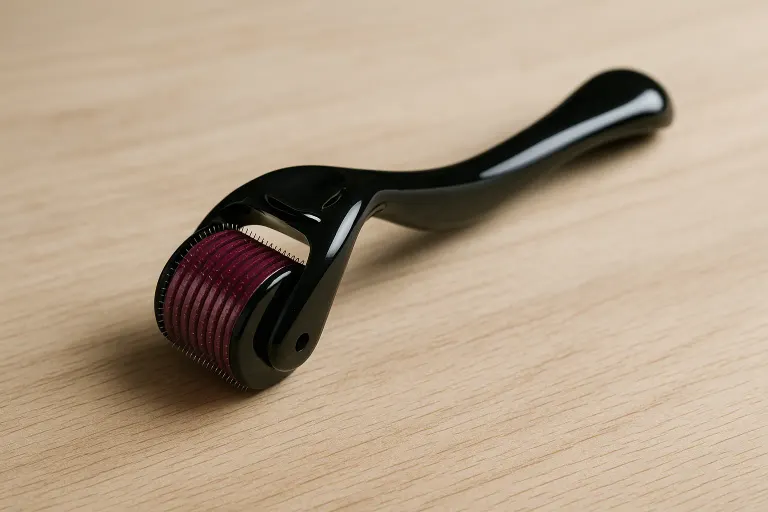
Dermarollers are handheld rollers covered in tiny needles, and they have become an increasingly popular way to treat hair loss. Rolling one over the scalp (microneedling) makes lots of tiny injuries in the skin. This is thought to trigger the body’s natural healing response and release factors that could help regrow hair or thicken the hair that is already there[1][2]. Results can vary with the cause of the hair loss, and with whether the microneedling is combined with proven therapies like minoxidil or platelet-rich plasma (PRP)[3][4].
How microneedling stimulates hair growth
Microneedling (also called collagen induction therapy) means puncturing the scalp with dozens of fine, sterile needles, using a dermaroller, a dermastamp, or a dermapen[5]. The needles leave tiny wounds in the skin, sometimes called microchannels. This seems to help hair grow in two ways.
The first is wound healing. The body responds to the small, controlled injuries by releasing growth factors and cytokines to repair the skin, and these can activate stem cells in the hair follicles and promote new hair growth[6]. The scalp also produces more collagen and elastin, which may make it a healthier environment for the follicles[7]. In effect, microneedling “tricks” the body into sending healing signals (like more blood flow and nutrients) to the follicles, which may revive thinning hairs.
The second is better absorption. Topical hair loss treatments get deeper into the scalp through the tiny punctures, so minoxidil (Rogaine), finasteride solutions, growth factor serums, or PRP reach the follicles more effectively when they are applied right before or after microneedling[8]. Studies have found that these medications work better combined with microneedling than on their own[4][9].
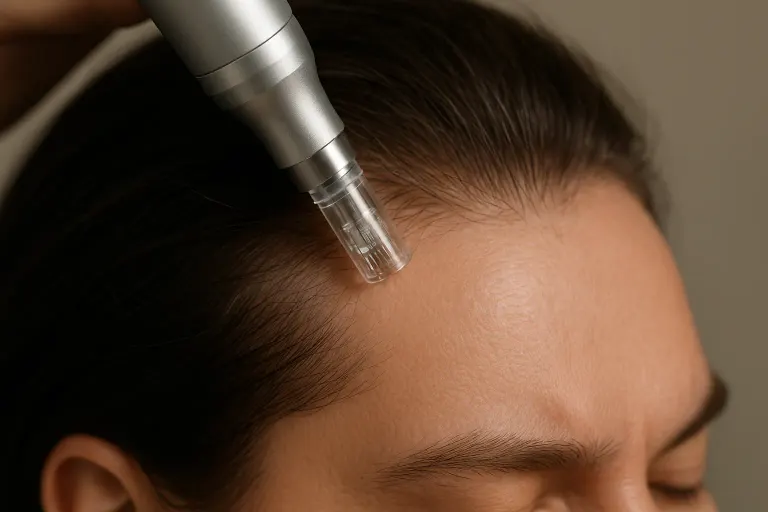 Figure: A demonstration of a microneedling device being applied to the scalp along the hairline. Creating uniform micro-punctures in areas of thinning hair may stimulate follicle activity and improve absorption of topical treatments (device shown: a professional dermapen)
Microneedling mainly helps in early to moderate hair loss, where hair is still present but thinning. It works more like “fertilizing” weak follicles that already exist. It tends to thicken and strengthen miniaturized hairs, which makes the hair look fuller, but it does not create new follicles[10][11][12]. In completely bald areas, where the follicles have “shriveled up and died” or scarred, microneedling alone cannot bring hair back[11]. One hair restoration expert puts it bluntly: treating a shiny bald scalp is “a lost cause”[11].
What the studies show
Clinical studies, including randomized trials and reviews, largely support microneedling as an add-on (adjunct) therapy for regrowing hair, especially in androgenetic alopecia (pattern baldness).
Microneedling with minoxidil
In a 12-week trial of 100 men with androgenetic alopecia, one group had weekly microneedling plus 5% minoxidil twice a day, and the control group used minoxidil alone[13][14]. The combination group did significantly better: 82% of the microneedling patients had more than 50% improvement in hair regrowth, compared with 4.5% of those using minoxidil alone[15][16]. The microneedling patients also grew thicker hair, reported higher satisfaction, and still had their gains 8 months after the trial[17][18].
A smaller case series followed four men who had grown no new hair despite 2 to 5 years on finasteride and minoxidil. After weekly microneedling was added to their routine, their regrowth sped up within 6 months[19][20]. That suggests microneedling may “jump-start” follicles in people who did not respond to the standard treatments alone.
Reviews and meta-analyses
A 2021 systematic review of 22 studies (1,127 patients) concluded that microneedling is a “generally positive” adjunct therapy for hair loss, especially alongside minoxidil or PRP, though it is not typically effective as a treatment on its own[21][22][41]. A 2023 review of 8 studies (466 patients) found it most effective when combined with minoxidil, with clear improvements in hair count and density compared with other approaches[23][24].
A 2025 systematic review and meta-analysis pooled 12 randomized controlled trials with 631 patients in total[25][26]. Adding microneedling to minoxidil raised hair counts significantly more than minoxidil alone (pooled standardized mean difference about 1.3, p < 0.01)[25][26], and hair shaft diameter also improved modestly[27][28]. Needle depth (about 0.5-1 mm or more than 1 mm), treatment frequency (weekly or monthly), and device type (manual roller or electric pen) made no significant difference to hair counts[26][29]. So a range of approaches seems to work, as long as the technique is done properly and combined with treatment. Patients’ own assessments in these trials also favored the combination[26].
Other combinations
One 2022 study found that in men and women with moderate androgenetic alopecia, PRP injections plus microneedling gave better hair density than PRP alone[30][31]. In small trials, microneedling with topical anti-androgens (like finasteride solutions or spironolactone) or with growth factor serums has improved hair diameter and density[32][33]. Across the studies in one review, needle length, intervals, and add-on treatments varied widely, yet almost all treatment groups saw some improvement in hair measurements[34][35]. It usually takes multiple sessions (often at least 4-6 over a few months) to get meaningful regrowth[36].
Microneedling on its own
Microneedling without medication has not been studied as much. One 2022 review did find that microneedling alone increased hair count more than minoxidil alone, which suggests it has some benefit by itself[37]. Combination therapy is still more effective than microneedling by itself[37][4], and no large trial has established microneedling alone as a reliable cure for pattern hair loss[38][39].
What dermatologists say
“There’s not enough quality data to say whether microneedling by itself would be an effective hair loss treatment,” says Dr. Knox Beasley, a board-certified dermatologist, “but there are studies showing that it can help improve results from topical medications when treating male pattern hair loss”[22]. Dr. Beasley stresses that it should not replace medical therapies like finasteride or minoxidil for androgenetic alopecia, though it can improve results as part of a combined plan[22][40].
“A lot of times we use it where there are those little, fine, miniaturized hairs, or baby hairs, that are on their way out,” says Dr. Julie Kinler, a hair restoration specialist[42][43]. Reviving these weak follicles can reverse some thinning, while long-standing baldness or scarring alopecia needs a hair transplant or another treatment instead[44]. The only time she has really seen microneedling help, she says, is “when you combine it with [growth] factor therapy… applied to the scalp after the little microchannels are created.” Without something like PRP or a topical growth solution, the benefits are limited[45]. Patients also need to keep up their other treatments (daily minoxidil, for example), or much of the potential benefit is lost[46][45].
Dr. Kinler usually avoids recommending scalp microneedling at home because “there’s a higher risk of causing damage to the hair…if the needle depth is too much,” among other safety issues[53][54]. Some hair specialists are exploring alternatives like radiofrequency microneedling or laser treatments (such as the “KeraLase” laser), which create microchannels without mechanical needles[61][62]. These may be less likely to damage existing hairs, but they are newer and less studied than traditional microneedling. In sensitive areas she often prefers the laser, to avoid any chance of microneedling-induced hair loss along a fragile frontal hairline[63].
“Consistency is key. This isn’t an overnight fix,” says Dr. Arash Kashian, a hair transplant surgeon[47][48]. In clinics, patients often have a session every 4-6 weeks for the first 6-8 months, then taper off to maintenance treatments, perhaps a few times a year[49][50]. It usually takes at least a few months (3-6 or more) to see thicker or denser hair, and not everyone responds well enough to be satisfied[51][52]. Dermatologists often track progress with photos and ask patients to give it at least half a year before judging the results[51][52]. They advise patients to expect gradual gains and to have the procedure done under medical guidance[4][64].
How the treatment is done
In a clinic, a dermatologist or trained provider uses a sterilized device to puncture the scalp where the hair is thinning. Common devices are a rolling cylinder covered in needles (a dermaroller) or an automated dermapen that rapidly stamps up and down[65][66]. A scalp treatment usually takes about 20-30 minutes, and a numbing cream is applied first to reduce the pain[67][68]. The needles go over thinning areas (along a receding hairline, the crown, or areas of diffuse thinning), usually not over fully bald, shiny skin[69][70].
Needle length
Professional microneedling for hair loss uses medical-grade devices (often motorized pens) with controlled needle depths, usually about 1.0 to 1.5 mm for the scalp, according to Dr. Kashian[55][56]. Needles that long can reach the bulge region of the hair follicle, where important stem cells sit[71][72], and reaching that depth is thought to matter for stimulating the follicle cells. The aim is to get there without going so deep that the needles injure the follicles themselves.
Dermarollers sold for home use often have shorter needles, around 0.25 to 0.5 mm[73]. Dr. Robert Nettles, a hair specialist answering on RealSelf, recommends that home users stick to 0.25-0.5 mm needles at most, which is just enough to help minoxidil absorb, and says “you should not be drawing blood” with a home roller[73][76]. Needles long enough to draw blood or go deep raise the risk of infection, scarring, or even damage to the hair roots, so non-professionals should not use them[74][75]. Needles longer than 1 mm should be kept for medical settings, where sterility and technique are controlled to avoid complications[72][77].
How often
There is no strict consensus on how often to microneedle for hair growth. Clinical studies have used schedules from twice a week to once a month, over periods of 2.5 to 6 months[78][79]. In practice, sessions are usually about 3-6 weeks apart, which gives the scalp enough time to heal in between[80][81]. Microneedling too often (daily, for example, or several times a week with deep needles) does not help and can cause chronic inflammation or scarring[82][83]. Verywell Health advises against microneedling more than once a week, even with a home roller[80][84].
Technique and hygiene
A clinician stamps or rolls the device across the area, often in several directions (horizontal, vertical, diagonal), so the microchannels cover it evenly[85][86]. The needles must be disinfected or single-use. Patients are asked to arrive with a clean scalp (washed with a mild shampoo) and to avoid hair products and harsh chemicals before the treatment[87][85].
Using a dermaroller at home
Some people microneedle at home with a store-bought dermaroller to save money. If you do, be extremely careful. Disinfect the device and your scalp thoroughly (for example, soak the roller in 70% isopropyl alcohol for about 20 minutes before use, and again afterward)[85][86]. Use gentle pressure, just enough to press the needles in, and never scrape. Rolling each section a few times in a crisscross pattern is enough[88][89]. The usual advice is to wait 24-48 hours after a session before applying minoxidil or other products, to avoid excessive irritation (though some protocols apply it immediately, so advice differs)[90][89].
Unsupervised microneedling at home is risky because it’s easy to use the wrong needle size, press too hard, or sterilize poorly, which can lead to infection or scarring[59][91]. As Healthline notes, you might end up needing a doctor anyway if complications arise, so “it’s much safer to leave these devices in the hands of a licensed and experienced professional”[92][60]. Talk to a dermatologist before you start microneedling at home.
Combining it with other treatments
Right after microneedling, many providers apply a topical treatment (minoxidil, a growth serum, or PRP injections) to take advantage of the open channels[8]. With PRP, some even use the microneedling device to inject it, on the reasoning that its growth factors will penetrate deeper and stimulate the follicles further[93][94]. Others have patients apply minoxidil the night before or a day after treatment, since applying it immediately after needling means more of it is absorbed, which can cause intense burning or irritation[95][96]. A professional should tailor the exact regimen, including when to restart topical treatments, to the patient’s type of hair loss and tolerance.
Side effects and risks
Microneedling is minimally invasive, and when it is done correctly, its side effects are generally mild and temporary. The American Academy of Dermatology notes that most subside within about 5 days[99][100].
Expect redness (erythema) in the treated areas for 1-3 days afterward, possibly with some swelling or mild tenderness[101][102]. The skin may flake or peel a little as the tiny wounds heal[103]. Longer needles can cause tiny dots of bleeding, which are usually minimal and stop quickly. Mild bruising can also happen, especially with deeper needling or in patients on blood thinners[101][102].
The procedure itself can be uncomfortable (often described as tingling or prickling), but numbing cream makes it quite tolerable in a clinic. Afterward the scalp may feel sore or “sunburnt” for a day or two[102][104].
Some patients notice more shedding in the weeks after they start microneedling. This is usually a temporary “shock shed” as new, healthier hairs push out the old ones, similar to what happens with minoxidil. Short-term shedding and scalp itching have also been reported with PRP plus microneedling[105][106].
Infection is rare but serious if the procedure isn’t sterile. The punctures break the skin barrier, so bacteria that get in can cause folliculitis or abscesses. Cleaning the scalp and tools properly, and sometimes using an antibiotic ointment or oral antibiotics afterward, is important to prevent infection[107][108].
In licensed clinics, infection appears to be very rare. Dr. Kashian says that after performing thousands of microneedling treatments, they had “never seen an infection” in their patients[109][110]. At home the risk is higher if you aren’t scrupulous about disinfection. Persistent redness, warmth, pus, or fever can be signs of infection and should be treated right away.
Done improperly (too deep or too often), microneedling could in theory cause scarring alopecia, which is permanent damage to the follicles. This is very unlikely when professionals use appropriate needle lengths. There are anecdotal cases of people overusing home dermarollers and ending up with small scars or bald spots, and Dr. Kinler warns that overuse can break hair shafts near the surface and that needles that go too deep can cause patchy permanent hair loss[111][57][58]. People prone to keloid scars should be especially careful, since any skin injury can form a raised keloid. Most studies report no scarring when microneedling is done at the recommended depths and intervals[112][113].
Microneedling is generally not recommended for people with active scalp conditions like severe psoriasis or eczema, since it could make the inflammation worse[114]. People with bleeding disorders or on anticoagulants should ask a doctor first, as they may bruise or bleed more from the procedure[114][115]. It is also contraindicated during pregnancy as a precaution, and on any area with an active infection or acne.
Aftercare
The scalp’s barrier is weakened for a while after microneedling. Clinics usually advise gentle care for a few days: keep the area clean, avoid touching or scratching it, and protect it from the sun (wear a hat and use sunscreen)[116][117]. Avoid saunas, pools, and intense exercise (sweating) for 1-2 days to reduce the risk of infection[118][119]. Follow any specific instructions you’re given, such as using a prescribed soothing lotion or antibiotic solution.
Which types of hair loss it helps
Dermarollers work best for non-scarring hair loss, where the follicles are still there but sluggish.
Pattern hair loss (androgenetic alopecia)
Androgenetic alopecia is the most common type of hair loss, driven by genetics and hormones (DHT), and it is the main condition microneedling is used to treat[120][121]. The follicles gradually shrink (miniaturize), and microneedling has shown benefits in both male and female pattern thinning by reactivating them, especially when combined with therapies that block DHT or stimulate growth. Virtually all the studies discussed above are about androgenetic alopecia. Microneedling can help this inherited hair loss to a meaningful degree[1][64]. For men, this means it can improve a receding hairline or a thinning crown (as long as some fine hairs are still present). For women, it can help with diffuse thinning or a widening part. As a booster to standard treatments, it often gives visibly thicker hair in areas of mild to moderate balding[4][64].
Alopecia areata
Alopecia areata is an autoimmune condition in which the immune system attacks the hair follicles, causing patchy hair loss. The standard treatments are corticosteroid injections or topical immunotherapy. Microneedling is not a first-line therapy for it, but there is some evidence it can help in stubborn cases. A 2014 report described two patients whose alopecia areata patches had not responded to steroid injections, topical steroids or minoxidil, but regrew well after three sessions of microneedling combined with a topical steroid[97][98]. The microneedling likely improved delivery of the steroid and had a local immune-modulating effect.
Microneedling also triggers growth factors in general, which might counter some of the follicle “shutdown” in alopecia areata. Some clinics now offer microneedling with PRP to alopecia areata patients who don’t respond to conventional treatment, with anecdotal success. Alopecia areata can also go into remission on its own. Microneedling may be useful alongside other therapies (steroids, PRP), but there’s no guarantee and more research is needed[122][123]. A dermatologist should oversee it.
Traction alopecia
Hair loss from constant pulling (tight braids, ponytails) can sometimes be reversed if it’s caught early, before scarring. In theory, microneedling could improve blood flow and help regrowth once the pulling stops. If traction alopecia has already caused scar tissue, though, microneedling is unlikely to regrow hair through the scars (one manufacturer claims it might help break down some scar tissue and stimulate follicles[124][125]). No solid studies look at microneedling for traction alopecia specifically, and it probably has limited benefit unless some follicles still work.
Telogen effluvium (stress or systemic shedding)
Telogen effluvium is diffuse shedding, often triggered by stress, illness, or nutritional deficiencies. The follicles aren’t damaged; they’re in a resting (shedding) phase after a shock to the system. The main approach is to remove the trigger (reduce stress, correct deficiencies, and so on), after which hair usually grows back on its own within months. Microneedling is generally not needed, since the follicles just need time to cycle back. In theory, a gentle microneedling routine with something like PRP could speed up regrowth in some chronic cases by helping the follicles return to the growth phase sooner. There is no clear evidence or recommendation for this, though[126][127].
Scarring alopecia
In scarring alopecias (such as lichen planopilaris, frontal fibrosing alopecia, or lupus), inflammation destroys the hair follicles and replaces them with scar tissue, so the baldness in those areas is permanent. Once a follicle has scarred over, micro-injuries won’t bring it back[128][129]. In active scarring alopecia, extra injury could even make the scarring worse, so microneedling is not indicated for true scarring alopecia. The priority in these diseases is immunosuppressive or anti-inflammatory treatment to stop the process.
Getting a diagnosis first
If the hair loss comes from an underlying medical issue (thyroid problems, severe stress, and so on), treating that issue comes first. Microneedling might be considered later if some areas don’t recover on their own[126][127]. As one answer on RealSelf put it, “you need a formal evaluation to see what type of hair loss you have” before deciding on treatment[130][131]. See a dermatologist, who can work out the type and put together a complete treatment plan, which may include microneedling, FDA-approved medications, and lifestyle changes[143][130].
What users report
Many people have shared their results with dermarolling for hair growth on forums and review sites. These are anecdotes, but they give some sense of how it works in real life, along with practical tips.
A number of users report encouraging results, especially when they combine microneedling with other hair growth treatments. One RealSelf user described a series of Kerafactor (growth factor) microneedling treatments. After three monthly sessions, she was “thrilled” to see thicker hair and less shedding[132]. She noted that switching to a hair growth supplement (Nutrafol) and having microneedling done by a professional greatly reduced the hair falling out when she washed it[132][133]. Reviews like this often mention more confidence and satisfaction as hair density increases modestly, and there is also a psychological benefit to “doing something” more about hair loss.
Users also stress consistency. Those who keep up weekly or monthly microneedling for several months tend to see baby hairs filling in or existing strands getting fuller, while the impatient ones end up disappointed.
On hair loss forums (like Reddit’s r/tressless or HairLossTalk), many users say they saw no results from minoxidil alone. After adding weekly dermarolling at home (with a roller of about 1 mm), they started to see new growth or thickening after 2-3 months. They often put this down to better absorption of minoxidil. Some have posted before-and-after photos showing a visibly better hairline or denser crown after combining microneedling and minoxidil (though other variables and the placebo effect have to be considered). Other users saw little or no change, and a few “non-responders” found that their genetic hair loss continued even with diligent microneedling and minoxidil. Results vary a lot from person to person, so what worked for someone else may not work for you.
Home users often talk about the discomfort and the learning curve. Pain tolerance varies: some find a 1 mm roller on the scalp quite painful even with light pressure, while others call it “very manageable, just a tingling.” The forehead and hairline tend to be more sensitive than the back of the scalp. Numbing creams usually aren’t used at home, so some users pick a shorter needle (0.5 mm) to reduce the pain, accepting that it might be slightly less effective.
Microneedling at home also adds another step to the routine, and users mention spending about 10 minutes rolling once or twice a week. Sanitizing everything is tedious but necessary. One user wrote that they soak their dermaroller in alcohol and carefully clean their scalp, and so far have had no infections and good results. Some users eventually decided it was worth paying a clinic now and then, to avoid the hassle and get a consistent depth.
Some reports are cautionary. A few people have posted that they pressed too hard or used a dermaroller too often and ended up with scabs, lingering scalp inflammation, or even more shedding. That matches the medical advice that overdoing it can do more harm than good. One user said that after aggressive daily needling, they noticed thinner patches (likely from trauma to the follicles), which mostly recovered after they stopped and let the scalp heal.
On Q&A sites like RealSelf, people often ask doctors about microneedling. The answers vary, but most doctors there are positive about it as part of a broader plan (one writes that it “can help with hair loss and provide regrowth”)[134], though a few are skeptical about using it alone[135]. Patients often mention these answers in forums, which lends the method some credibility. Some users also saw a dermatologist in person who recommended trying microneedling, and that recommendation gave them the confidence to stick with it. When a doctor advised against it for a particular person (say, because their hair loss was too advanced), users have shared that they moved on to alternatives like transplants.
The main studies and expert comments
| Source or expert | Findings and comments |
|---|---|
| Dhurat et al., 2013 (RCT) 100 men with pattern hair loss | Microneedling (1×/week) + 5% minoxidil gave better regrowth than minoxidil alone. After 12 weeks, 82% of the microneedling group had >50% hair improvement, compared with 4.5% of the control (minoxidil-only) group[15][16]. Participants kept their gains 8 months after treatment[17][18]. |
| Clinical trials (multiple) e.g. 2021, 2022 RCTs | Repeated studies confirm that combination therapy works best. Patients who had microneedling plus another therapy (minoxidil, PRP, or finasteride) saw higher hair density, thickness, and satisfaction than those on a single therapy alone[33][136]. A minimum of ~4 sessions was often needed for significant results[36]. |
| Ahmed et al., 2025 (meta-analysis) 12 RCTs, 631 patients | Combining microneedling with minoxidil led to significantly higher hair counts and thicker hairs than minoxidil alone in androgenetic alopecia[25][26]. The benefit was consistent regardless of needle depth (≈0.5-1.5 mm), session frequency, or device type[26][29]. Mild side effects (redness, pain) were more frequent with microneedling but generally went away on their own[28][137]. |
| Dermatologist Dr. K. Beasley Board-certified (via Hims, 2025) | “Not enough quality data” to endorse microneedling alone, but it “can help improve results” from topicals in male pattern hair loss[22]. Recommends it as a supportive treatment, safe and well tolerated when done properly (only minor redness or pain)[138][139]. Advises cleaning tools and starting slowly (don’t overdo it)[138][139]. |
| Dr. Robert Nettles Hair specialist (RealSelf, 2021) | States flatly: “Microneedling by itself will not regrow hair.” Its value is in creating channels for better absorption of topical solutions[140][73]. Recommends home needles of only 0.25-0.5 mm (no bleeding) and rolling immediately before applying minoxidil to help it penetrate[140][74]. Stresses getting an accurate diagnosis of the cause of hair loss alongside any treatment[141]. |
| Dr. Julie Kinler Hair restoration surgeon (Shape, 2024) | Observes that microneedling thickens existing miniaturized hairs but does not create new follicles[10][142]. Fully bald areas won’t benefit (microneedling a shiny scalp is a “lost cause”)[11]. Warns that improper use (especially at home) can cause hair breakage or even patchy permanent loss if the needles go too deep[57][58]. Strongly prefers that qualified physicians do the procedure, and often favors combining it with PRP or using laser-based alternatives to minimize risk[53][61]. |
| Patient “Jennya808” RealSelf review (2021) | Describes significant improvement after 3 monthly Kerafactor microneedling sessions (with growth factors) for diffuse thinning. Reported less shedding and visibly thicker hair, writing “I am so thrilled to see the results…less hair was falling out” and that the treatment “helped me get my confidence back”[132][133]. Also used a hair supplement (Nutrafol) at the same time. |
Sources
[1] [3] [5] [6] [7] [8] [30] [31] [32] [33] [34] [35] [36] [37] [65] [66] [67] [68] [69] [70] [71] [72] [77] [78] [79] [80] [81] [82] [83] [84] [85] [86] [87] [88] [89] [90] [103] [105] [106] [116] [117] [118] [119] [120] [121] [126] [127] [136] [143] How Microneedling for Hair Loss Works
https://www.verywellhealth.com/microneedling-for-hair-loss-8379566
[2] [59] [60] [91] [92] [95] [96] [97] [98] [99] [100] [101] [102] [104] [107] [108] [114] [115] [122] [123] Microneedling for Hair Loss: Is It Effective?
https://www.healthline.com/health/microneedling-for-hair-loss
[4] [9] [13] [14] [17] [18] [19] [20] [21] [22] [23] [24] [38] [39] [40] [41] [64] [138] [139] Microneedling for Hair Loss: How It Works and Expert Insight From an MD | Good Health by Hims
https://www.hims.com/blog/microneedling-hair-loss
[10] [11] [12] [42] [43] [44] [45] [46] [47] [48] [49] [50] [51] [52] [53] [54] [55] [56] [57] [58] [61] [62] [63] [93] [94] [109] [110] [111] [142] Microneedling for Hair Loss: What You Need to Know
https://www.shape.com/lifestyle/beauty-style/microneedling-for-hair-loss
[15] [16] [128] [129] Hair Loss and Microneedling Montclair, NJ
https://auroradejuliismd.com/hair-loss/
[25] [26] [27] [28] [29] [112] [113] [137] Evaluating the efficacy and safety of combined microneedling therapy versus topical Minoxidil in androgenetic alopecia: a systematic review and meta-analysis - PubMed
https://pubmed.ncbi.nlm.nih.gov/40056230/
[73] [74] [75] [76] [130] [131] [134] [135] [140] [141] Micro needling for hair loss?
https://www.realself.com/question/orange-ca-micro-needling-hair-loss
[124] [125] Microneedling for Hair Loss: Before and After Results | DermapenWorld
[132] [133] Encouraging Results
https://www.realself.com/review/hair-loss-treatment-encouraging-results